Fort Lauderdale Mixed-Use Property Opportunities for Owners
April 2, 2026
April 2, 2026
If you own or are considering buying a small commercial property in Fort Lauderdale, mixed-use may deserve a closer look. In the right location, combining residential, office, or retail uses can create more flexible income and a property that responds better to changing market conditions. The key is knowing where mixed-use works, how Fort Lauderdale regulates it, and which risks can change the numbers fast. Let’s dive in.
Fort Lauderdale has the scale and consumer activity to support neighborhood-serving mixed-use property. The city’s estimated population reached 190,641 in 2024, Broward County reached 2,037,472, and median household income was reported at $83,130 in the city and $77,633 in the county, according to U.S. Census QuickFacts. City retail sales also reached $6.63 billion in 2022, while Broward County retail sales totaled $48.22 billion.
For owners, that matters because mixed-use usually depends on steady local spending and everyday demand. A property with residential units above and commercial frontage below often performs best when the surrounding area already supports shopping, services, dining, and foot traffic. In Fort Lauderdale, certain walkable corridors can offer that support better than the broader market.
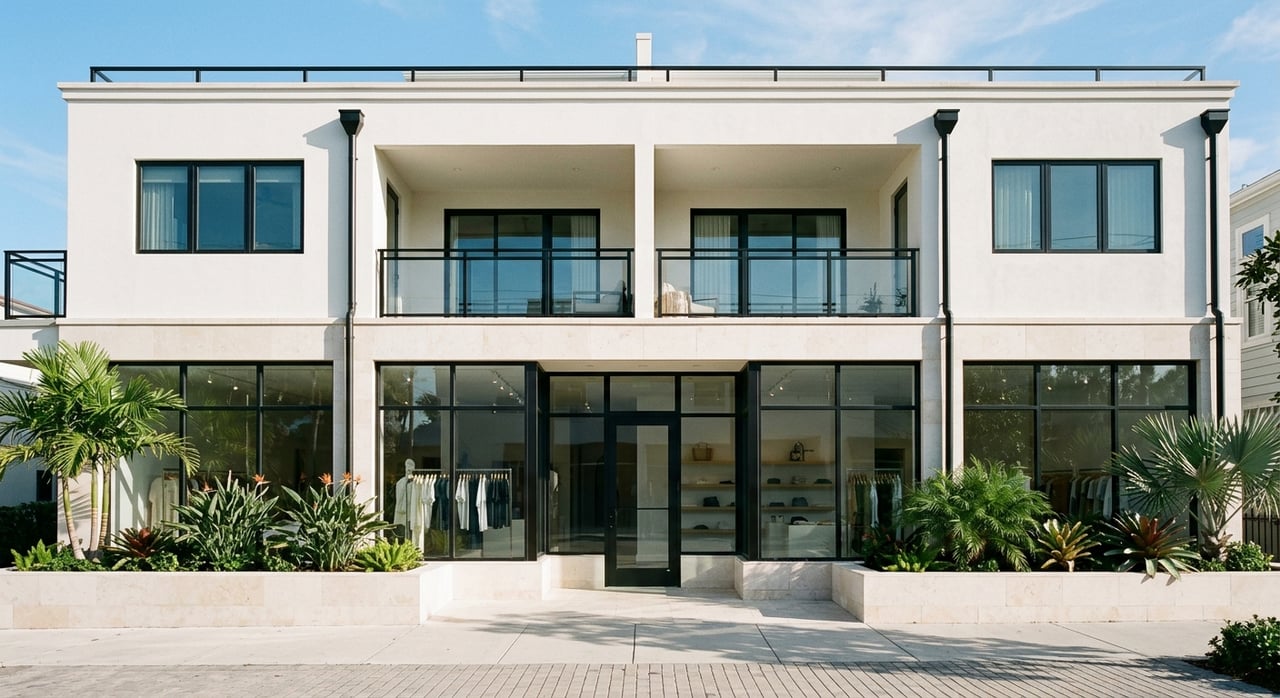
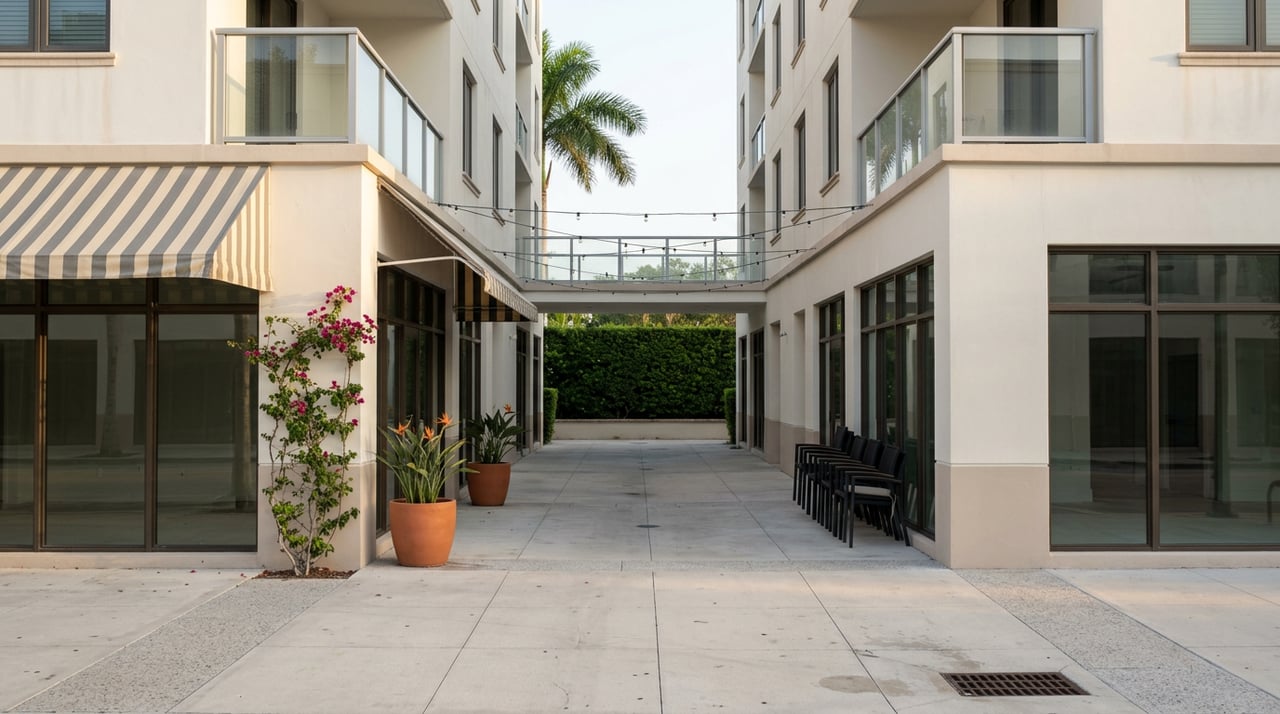
In Fort Lauderdale, mixed-use most often means more than one use working together in one property. That can include apartments over retail, office over retail, or a smaller building with commercial space at street level and residential or office space above.
You can see that pattern in local projects. The Six13 in Progresso includes 142 apartment units, a garage, and 5,991 square feet of ground-floor restaurant and commercial space. The Arcadian in Progresso Village includes 502 residential units, about 15,000 square feet of ground-floor commercial space, and a 629-space garage, also referenced through the same CRA project materials.
That local development pattern lines up with the city’s Downtown Master Plan, which describes downtown as an active urban center with housing, shopping, office space, entertainment, public spaces, and transportation options. For owners, the practical takeaway is simple: mixed-use in Fort Lauderdale is usually not a one-tenant gamble. It is a format where one use can help stabilize the other.
Not every mixed-use deal pencils the same way, because Fort Lauderdale’s office and retail conditions are uneven. According to Cushman & Wakefield’s Fort Lauderdale return-to-office insights, October 2024 office visits in Fort Lauderdale’s CBD were 90.7% of the February 2020 baseline. Its Q4 2025 retail reporting also showed downtown Fort Lauderdale retail vacancy at 7.3% with average asking rent of $50.82 per square foot, while Broward County retail vacancy was 4.0% with average asking rent of $35.39 per square foot.
Office leasing has remained more selective. CBRE’s Fort Lauderdale office figures for Q4 2025 noted that office asking rents in Fort Lauderdale rose 6.4% year over year, with downtown leading rent growth, while broader Broward office vacancy remained elevated based on the market reporting summarized in the research.
For you as an owner, that points to a clear underwriting lesson. Retail frontage in a strong pedestrian corridor may support premium rents, but office space often requires more careful positioning, leasing strategy, and patience. Visibility, parking, walkability, and tenant mix can matter just as much as the building itself.
Fort Lauderdale does not treat mixed-use as a simple citywide category. The city regulates it through specific land development standards, which means zoning and entitlement work should be part of your analysis from day one.
Under Section 47-18.21 of the ULDC, mixed-use development must align with the underlying district’s allowed residential and business uses. The code also adds conditional review requirements and standards tied to sidewalks, plazas, and dimensions.
Within downtown, the RAC districts help define the local pattern. Under the city’s RAC district standards, RAC-CC is the higher-intensity core where mixed use and ground-floor retail are expected on pedestrian streets, RAC-UV supports mixed use with residential above business uses, and RAC-TMU districts are intended to transition between the core and surrounding areas.
The city is also actively reviewing mixed-use corridor standards. Current updates include work on form-based regulations for major corridors, with attention to neighborhood transitions, streetwall length, podium stepbacks, and floorplate size.
That means two properties only a few blocks apart may have very different development or repositioning paths. Before you assume a parcel can support your plan, you need to confirm the district, standards, transition rules, and approval path.
If you are looking at a mixed-use acquisition or repositioning opportunity, start with the basics that affect both use and income:
A strong mixed-use property is rarely just about price per square foot. In this asset class, design, frontage, regulation, and operations all influence value.
If you plan to occupy part of the property for your own business, SBA programs may be relevant. According to the SBA 7(a) program overview, 7(a) loans can be used to acquire, refinance, or improve real estate and buildings, with a maximum loan amount of $5 million.
The SBA also states that 504 loans are long-term fixed-rate financing for owner-occupied commercial real estate and cannot be used for speculation or investment in rental real estate. That distinction matters if you are comparing an owner-user strategy against a pure investment approach.
For some owners, this creates a practical path: occupy one portion of the building, lease the rest, and structure the property to support both operations and income. That said, financing should match how the building will actually be used, not how you hope it may evolve later.
In mixed-use property, rent alone never tells the full story. The structure of each lease can change your cash flow, reserves, and risk profile in a major way.
The SBA’s commercial leasing education materials discuss several lease types and specifically note NNN leases. Cornell Law School’s Legal Information Institute explains that NNN leases typically shift insurance, maintenance, and taxes to the tenant in addition to rent and utilities.
That matters because a property with a well-structured commercial lease may produce more predictable net income than one with a similar face rent but heavier owner expenses. If your building mixes residential and commercial uses, you need to review each side separately and understand which costs stay with you.
In Fort Lauderdale, flood and storm risk are not side issues. They are part of the core underwriting.
The city has stated that Fort Lauderdale is especially vulnerable to flooding from heavy rainfall, king tides, and storm surge in its flood awareness guidance. FEMA also notes that flood maps are the official tool for checking flood hazard, and the city reminds owners that standard homeowners insurance does not cover flood damage.
For a mixed-use owner, flood exposure can affect insurance costs, lender requirements, renovation budgets, drainage improvements, and long-term hold strategy. Before you move forward, it is worth confirming flood zone, elevation context, drainage conditions, and likely insurance needs.
Some Fort Lauderdale areas also offer public support that can improve a project’s return. The NPF CRA’s Non-Residential Façade Improvements Program offers forgivable loans up to $125,000 for exterior improvements and explicitly includes mixed-use properties with residential and commercial uses.
That kind of program can matter if your strategy depends on improving curb appeal, modernizing storefront presentation, or repositioning an older asset for stronger tenancy. It also signals that certain submarkets have policy support behind reinvestment, not just private market momentum.
In my view, the strongest owner-oriented mixed-use opportunities in Fort Lauderdale usually share a few traits:
This is why the best opportunities are not always the biggest buildings or the highest advertised yields. Often, the better play is a well-located asset with flexible use, clear zoning, and a practical path to stable occupancy.
If you are considering a mixed-use property in Fort Lauderdale, it helps to slow the process down before you speed it up. A quick review of zoning, lease terms, flood exposure, and corridor direction can save you from expensive surprises after contract.
I work with buyers, sellers, and small commercial clients who want clear guidance through these details, especially when a deal involves more than one use and more than one income story. If you are exploring a purchase, sale, or repositioning strategy, you can schedule a free consultation with Eric Edward Exhibits.
Stay up to date on the latest real estate trends.

Eric Periu
Primary phone
Address
20803 Biscayne Blvd
Aventura FL 33180